Showing posts with label spacecraft. Show all posts

Wednesday, October 26, 2011

A Thousand Dollar Sprite...

One of the Sprite nanosatellites (Photo: KickSat)


Pssst, do you wanna buy a satellite? No, really - do you? Well, Zac Manchester would like to sell you one. Not only that, but he claims that the thing could be built and launched into orbit for just a few hundred dollars. For that price, however, you're not going to be getting a big satellite. Manchester's Sprite spacecraft are actually about the size of a couple of postage stamps, but they have tiny versions of all the basic equipment that the big ones have.


One of the Sprite nanosatellites (Photo: Cornell University)


Zac is a graduate student in Aerospace Engineering at Cornell University, and was part of the team that originally designed the Sprites for use as space probes - the idea being that they could travel on solar winds, like cosmic dust, traveling deep into space without the need for fuel. Three of the one-square-inch spacecraft were delivered to the International Space Station this May, to see how they how well they could stand up to the rigors of outer space. They are currently still mounted on the outside of the station, and are due to be brought back to Earth in a couple of years.
Each Sprite incorporates a Texas Instruments MSP430 microcontroller, a radio transceiver, solar cells, capacitors and antenna. In their current incarnation, they can't do much more than transmit simple bits of data, but Manchester says that future versions could easily include sensors such as thermometers or cameras.


The KickSat satellite will carry hundreds or even thousands of the Sprites into orbit (Image: KickSat)


A small box-like satellite - or CubeSat - would be used to carry the Sprites into low-altitude orbit. It could contain hundreds or even thousands of spring-loaded Sprites, which would shoot out as soon as the CubeSat's lid was opened from ground control via a radio signal.
Once in orbit, the Sprites' transmitted radio signals would be monitored by a network of amateur ground-based tracking stations. The aim would be to demonstrate their communications capabilities, while also observing how long they remained in orbit, and how well they were able to perform in outer space. They should all burn up when they re-enter the earth's atmosphere, within a few days or weeks of their release.
Manchester is now raising funds for the demonstration project via the Kickstarter fund-raising website. Depending on how much money is raised, his team will either have to wait for a spot on one of several free launch programs, or be able to purchase a commercial launch of their own. If they are able to purchase a launch, he is hoping for the Sprites to be in orbit by early 2013.
Yes, but how do you get to call one of them your own? By contributing US$300 via Kickstarter, that's how. Such a donation will allow you to name one of the Sprites, specify the four-character message that it will transmit (such as your initials), and track it on the KickSat website. A donation of $1,000 or more will put an actual physical Sprite in your hands, and provide you with the source code and programming tools to write its custom flight code. Should you wish to set up your own ground station, you will also be instructed on how to receive and interpret its radio signal.
Groups are also encouraged to sponsor fleets of Sprites, each one of which will bear that group's logo on its lilliputian surface.

By Ben Coxworth for Gizmag
Original article HERE.

Tuesday, May 24, 2011

A Safe Return Home

The Soyuz TMA-20 near the ISS

After spending 157 days docked to the ISS, the Soyuz TMA-20 spacecraft, with Russian cosmonaut Dmitri Kondratyev at the controls, undocked from the Rassvet module at 21:35 UTC on 23 May 2011. The ISS was flying above eastern China at the time separated.The Soyuz executed its deorbit burn at 01:36 UTC on May 24. The descent, habitation and propulsion modules making up the spacecraft separated at 02:01 UTC. The descent module, with the crew inside, reached the first traces of the Earth's atmosphere at an altitude of about 62 miles at 02:03 UTC.


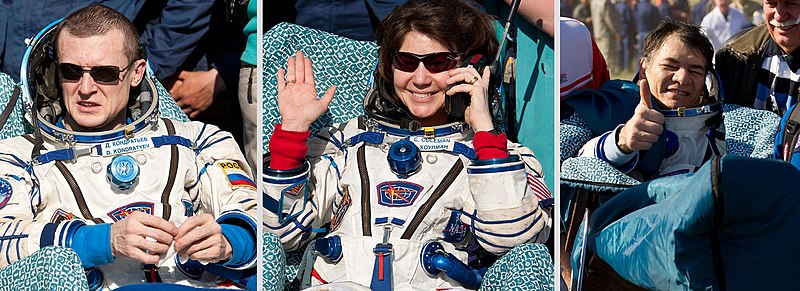
Russian cosmonaut Dmitri Kondratyev,NASA astronaut Catherine Coleman and ESA astronaut Paolo Nespoli pictured shortly after landing today.


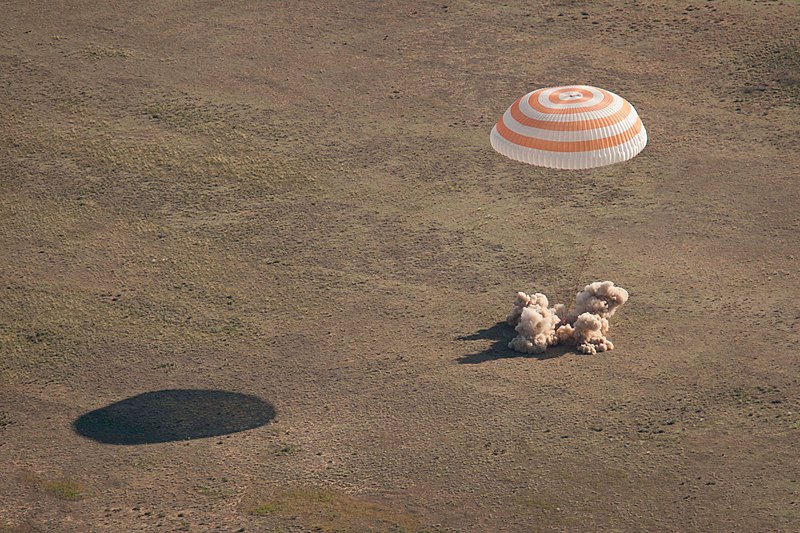
A perfect landing in Zhezkazgan,  Kazakhstan.
The Soyuz TMA-20 spacecraft landed safely at 02:27 UTC on 24 May 2011, after a mission lasting 159 days, seven hours and 17 minutes.

The re-entry was conducted without any significant problems. Soyuz TMA-20's large parachute and smaller drogue chute inflated as planned, and the spacecraft descended towards its landing zone in Kazakhstan. Welcome Home!

From Wikipedia, the free encyclopedia

Friday, May 20, 2011

Voyager 1 & 2 Where Are They Now?

Voyager Spacecraft


Voyager 1 & 2 are currently traveling at over 37,000 mph (60,000 km/h) through space. The car-sized spacecraft are about 3 billion miles apart now and an incredible 11 billion miles (17 billion km) and 8 billion miles (14 billion km) from Earth.  Together their mission is the longest continuously operated space mission and have traveled farther than any man-made craft, they will soon enter what is called interstellar space.Interstellar space is the physical space within a galaxy not occupied by stars or their planetary systems.Both Spacecraft are expected to continue to operate for the next 25 to 30 years.
Click to enlarge.

Titan III E
The Voyager 1 aboard the Titan III/Centaur lifted off on September 5, 1977, joining its sister spacecraft, the Voyager 2, on a mission to the outer planets.

Voyager 2 Launch
Voyager 2 launched on August 20, 1977.

If they ever make contact with intelligent lifeforms during their journey, they each have 1 golden disc to tell our human story to whomever or whatever finds them.

Gold Plated Copper
The Voyager Golden Record.

Gold Plated Copper
Cover of the Voyager Golden Record.

From Wikipedia, the free encyclopedia
The Voyager Golden Records are phonograph records which were included aboard both Voyager spacecraft, which were launched in 1977. They contain sounds and images selected to portray the diversity of life and culture on Earth, and are intended for any intelligent extraterrestrial life form, or for future humans, who may find them. The Voyager spacecraft are not heading towards any particular star, but Voyager 1 will be within 1.6 light years of the star AC+79 3888 in the Ophiuchus constellation in about 40,000 years.
As the probes are extremely small compared to the vastness of interstellar space, the probability of a space faring civilization encountering them is very small, especially since the probes will eventually stop emitting any kind of electromagnetic radiation. If they are ever found by an alien species, it will most likely be far in the future as the nearest star on Voyager 1's trajectory will only be reached in 40,000 years.
As Carl Sagan (1934-1996) noted, "The spacecraft will be encountered and the record played only if there are advanced space-faring civilizations in interstellar space. But the launching of this 'bottle' into the cosmic 'ocean' says something very hopeful about life on this planet."Thus the record is best seen as a time capsule or a symbolic statement rather than a serious attempt to communicate with extraterrestrial life.